Terrain Rasterizer
Conversion of GPS data into 2.5D topographic maps
Loading...
Searching...
No Matches
Terrain Rasterizer

Overview

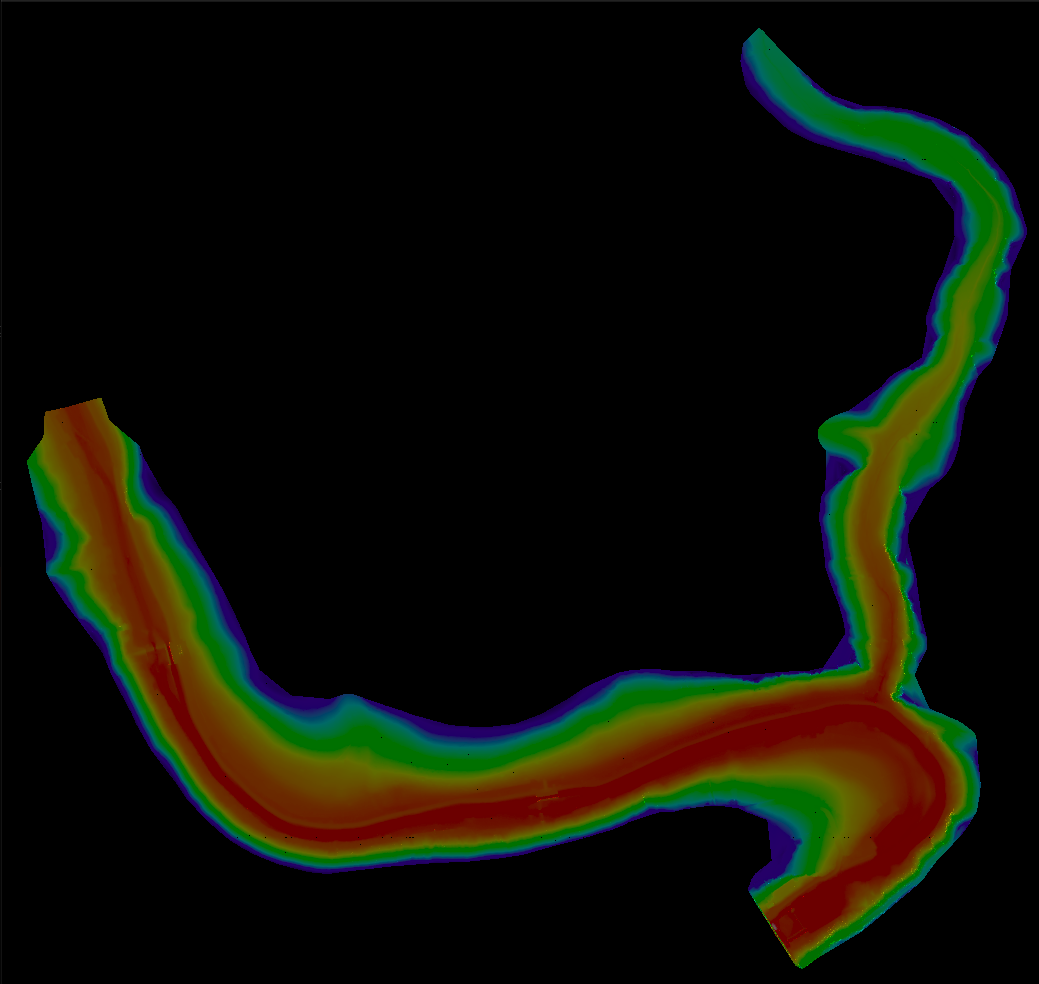
Terrain Rasterizer is a C++ application designed to transform raw geographic terrain data (latitude, longitude, altitude) into a visual 2D raster image. The project simulates a top-down view of the terrain, applying color mapping based on altitude and 3D shading to create a realistic Digital Elevation Model (DEM) visualization.

How It Works

The process is divided into a pipeline of distinct steps:

  1. Data Loading & Projection: The raw data usually comes in geographic coordinates (Latitude/Longitude). To visualize it on a flat 2D plane (like an image), we must project these spherical coordinates onto a flat surface. This project uses the Lambert93 projection (standard for France) via the PROJ library.
  2. Triangulation: The projected points are scattered and do not form a solid surface. To create a continuous terrain, we connect these points using Delaunay Triangulation. This creates a "mesh" of non-overlapping triangles that covers the area.
  3. Spatial Indexing (QuadTree): When generating the image, we check thousands or millions of pixels. For each pixel, we need to know "which triangle is underneath this?". Searching the entire list of triangles for every pixel is too slow. A QuadTree data structure is used to divide the space into smaller regions, making this search extremely fast.
  4. Rasterization & Rendering: The program iterates over every pixel in the output image:
    • It finds the corresponding triangle.
    • It calculates the exact altitude of that pixel using Barycentric Interpolation (a weighted average of the triangle's corners).
    • It assigns a color based on altitude (using a Haxby color map).
    • It calculates lighting/shading based on the slope of the triangle to verify depth perception.

Project Structure

Here is a breakdown of the key files and their responsibilities:

  • **src/main.cpp**: The entry point of the application. It orchestrates the entire workflow: reading arguments, calling the loader, running triangulation, and triggering image generation.
  • **src/MNT.cpp (Modèle Numérique de Terrain)**: Handles data ingestion. It reads the input text file and uses the PROJ library to convert coordinates from WGS84 (Lat/Lon) to Lambert93 (X/Y meters).
  • **src/triangulation.cpp**: Contains the logic to build the mesh. It uses the delaunator-cpp library to perform the Delaunay triangulation on the cleaned data points.
  • **src/quadtree.cpp**: Implements the QuadTree data structure. This is an optimization engine. It recursively splits the 2D space into four quadrants (NW, NE, SW, SE) to store triangles, allowing for efficient spatial queries.
  • **src/rasterizer.cpp**: The rendering engine. It:
    • Maps pixel coordinates to terrain coordinates.
    • Performs Barycentric Interpolation to find the Z (altitude) value for any point inside a triangle.
    • Applies a Haxby color map (Deep Blue -> Green -> Brown -> White) to represent elevation.
    • Computes Shading (Simulated Light) based on the surface normal of each triangle to give a 3D relief effect.
    • Saves the final result as a binary PPM image.

Building the Project

This project uses CMake. Ensure you have CMake, a C++ compiler, and the PROJ library installed on your system.

Prerequisites (Linux)

sudo apt-get install cmake g++ libproj-dev

Compilation

Run the provided build script or use standard CMake commands:

# Using the helper script
./build.sh
# OR manually
mkdir build
cd build
cmake ..
make

Usage

Run the executable create_raster with the path to your data file and the desired image width.

./build/create_raster <path_to_data_file> <image_width>

Example:

./build/create_raster data/terrain_data.txt 1000

This command will read data/terrain_data.txt, generate a 1000-pixel wide image, and save it as output.ppm.

Output

The program produces a file named output.ppm in the working directory. A PPM (Portable Pixel Map) file can be opened by most image viewers (like GIMP, IrfanView, or standard Linux image viewers).